


























Key Highlights
- Token Terminal’s latest Layer 1 validator ranking shows Ethereum at about 921.6K, versus 2.9K for Cardano, 1.6K for Algorand, and 784 for Solana.
- Ethereum.org separately lists about 922,228 total validators and 38.7 million ETH staked, underscoring the network’s much larger security base.
- Cross-chain comparisons still need context because Cardano counts stake pools, Solana cites 1000+ independent validators on mainnet, and Algorand says it had 3,075 nodes as of Q1 2025.
Ethereum remains the clear leader in validator-backed security among major Layer 1 blockchains, according to a recent cross-chain ranking that placed the network at roughly 922,200 validators. That was far ahead of Cardano’s 2,900, Algorand’s 1,600, and Solana’s 787, reinforcing how wide the gap has become between Ethereum and its nearest peers in raw validator scale.
@media only screen and (min-width: 0px) and (min-height: 0px) {
div[id^=”wrapper-sevio-e0d3bc50-0aae-47cc-a8d7-f0c9a0cef941″] {
width: 320px;
height: 100px;
}
}
@media only screen and (min-width: 1650px) and (min-height: 0px) {
div[id^=”wrapper-sevio-e0d3bc50-0aae-47cc-a8d7-f0c9a0cef941″] {
width: 728px;
height: 90px;
}
}
window.sevioads = window.sevioads || [];
var sevioads_preferences = [];
sevioads_preferences[0] = {};
sevioads_preferences[0].zone = “e0d3bc50-0aae-47cc-a8d7-f0c9a0cef941”;
sevioads_preferences[0].adType = “banner”;
sevioads_preferences[0].inventoryId = “502576df-3ba9-44d6-aa0c-8d4d40954bc3”;
sevioads_preferences[0].accountId = “265767db-939a-4138-8819-ebf4e3d5d360”;
sevioads.push(sevioads_preferences);
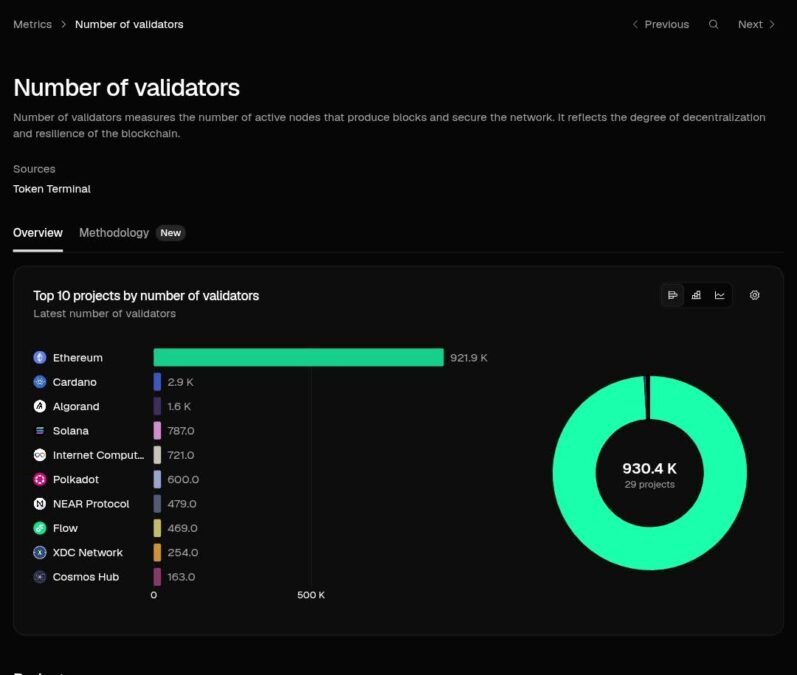
Ethereum’s own staking data points in the same direction. The network’s official staking page shows about 38,706,889 ETH staked and 922,228 total validators, highlighting the depth of capital securing the chain. Ethereum.org also says staking strengthens the network against attacks because an attacker would need to control a majority of validators and the majority of ETH in the system.
The ranking puts Cardano in second place, but the distance between the two networks remains enormous. In practical terms, Cardano’s validator-related count is only a small fraction of Ethereum’s, which makes the bigger story Ethereum’s overwhelming lead rather than a close Layer 1 race.
Still, the comparison needs context. Cardano’s official documentation says its proof-of-stake system is centered on stake pools, described as reliable server nodes run by stake pool operators, where ADA holders can delegate stake. Those pools hold the combined stake of various stakeholders in a single entity, meaning Cardano’s figure reflects a different staking structure from Ethereum’s validator model.
@media only screen and (min-width: 0px) and (min-height: 0px) {
div[id^=”wrapper-sevio-bf4b3de1-2d49-4069-adb2-b7d50bdcc555″] {
width: 320px;
height: 100px;
}
}
@media only screen and (min-width: 1650px) and (min-height: 0px) {
div[id^=”wrapper-sevio-bf4b3de1-2d49-4069-adb2-b7d50bdcc555″] {
width: 728px;
height: 90px;
}
}
window.sevioads = window.sevioads || [];
var sevioads_preferences = [];
sevioads_preferences[0] = {};
sevioads_preferences[0].zone = “bf4b3de1-2d49-4069-adb2-b7d50bdcc555”;
sevioads_preferences[0].adType = “banner”;
sevioads_preferences[0].inventoryId = “502576df-3ba9-44d6-aa0c-8d4d40954bc3”;
sevioads_preferences[0].accountId = “265767db-939a-4138-8819-ebf4e3d5d360”;
sevioads.push(sevioads_preferences);
Solana and Algorand also use different participation designs. Solana’s validator page says stakers delegate stake to validator nodes, while the network is supported by 1000+ independent validators. Algorand, meanwhile, says its network comprises repeaters and validators, with validators participating in Pure Proof-of-Stake consensus and anyone able to run one.
Even with those structural differences, the central takeaway is hard to miss: Ethereum remains in a league of its own on validator security. Cardano, Algorand and Solana continue to play important roles in the broader proof-of-stake market, but on raw validator scale, none of them are close.
Also Read: Ethereum Climbs 5%, Tracking Bitcoin’s Rise on Potential US-Iran Truce
