


























Key Highlights
- BTC fell ~3.58% to around $66,600 and ETH declined 3.54% to ~$1,990 as geopolitical risks in the Middle East weighed on risk assets.
- Both Bitcoin and Ethereum have broken below their 20/50/100/200 EMAs on the 1-hour chart, with RSI deeply oversold (BTC at 20.77, ETH at 20.60), signaling short-term weakness but potential for a relief bounce.
- Persistent shipping disruptions and recycled viral footage of tanker attacks in the Strait of Hormuz triggered the sell-off, with crypto continuing to trade like a high-beta risk asset rather than a safe haven.
Bitcoin slipped below $67,000 and Ethereum traded under $2,000 on Friday as traders kept a wary eye on the Middle East. The move came amid persistent tensions in the Strait of Hormuz, where shipping disruptions and past tanker attacks have kept risk assets on edge.
@media only screen and (min-width: 0px) and (min-height: 0px) {
div[id^=”wrapper-sevio-e0d3bc50-0aae-47cc-a8d7-f0c9a0cef941″] {
width: 320px;
height: 100px;
}
}
@media only screen and (min-width: 1650px) and (min-height: 0px) {
div[id^=”wrapper-sevio-e0d3bc50-0aae-47cc-a8d7-f0c9a0cef941″] {
width: 728px;
height: 90px;
}
}
window.sevioads = window.sevioads || [];
var sevioads_preferences = [];
sevioads_preferences[0] = {};
sevioads_preferences[0].zone = “e0d3bc50-0aae-47cc-a8d7-f0c9a0cef941”;
sevioads_preferences[0].adType = “banner”;
sevioads_preferences[0].inventoryId = “502576df-3ba9-44d6-aa0c-8d4d40954bc3”;
sevioads_preferences[0].accountId = “265767db-939a-4138-8819-ebf4e3d5d360”;
sevioads.push(sevioads_preferences);
On March 27, Bitcoin (BTC) traded around $66,600, down roughly 3.58% for the day after opening near $69,200—as per CoinMarketCap data. Ethereum (ETH) hovered near $1,990, shedding similar ground in a session that wiped several billion off the broader crypto market cap.
The dip extended a pattern seen throughout March, where geopolitical headlines have repeatedly pressured prices. Viral X posts amplified the sell-off by claiming a fresh Iranian strike on an oil tanker had triggered the drop, complete with dramatic footage.
The real pressure stems from ongoing friction. The Strait of Hormuz handles about one-fifth of global oil trade. Since the past few weeks, repeated threats, drone strikes, and attacks on shipping since late February have slowed tanker traffic, pushed insurance costs higher, and fueled uncertainty.
@media only screen and (min-width: 0px) and (min-height: 0px) {
div[id^=”wrapper-sevio-bf4b3de1-2d49-4069-adb2-b7d50bdcc555″] {
width: 320px;
height: 100px;
}
}
@media only screen and (min-width: 1650px) and (min-height: 0px) {
div[id^=”wrapper-sevio-bf4b3de1-2d49-4069-adb2-b7d50bdcc555″] {
width: 728px;
height: 90px;
}
}
window.sevioads = window.sevioads || [];
var sevioads_preferences = [];
sevioads_preferences[0] = {};
sevioads_preferences[0].zone = “bf4b3de1-2d49-4069-adb2-b7d50bdcc555”;
sevioads_preferences[0].adType = “banner”;
sevioads_preferences[0].inventoryId = “502576df-3ba9-44d6-aa0c-8d4d40954bc3”;
sevioads_preferences[0].accountId = “265767db-939a-4138-8819-ebf4e3d5d360”;
sevioads.push(sevioads_preferences);
Bitcoin falling below edge
Bitcoin’s 1-hour Bitcoin chart reveals a clear downtrend in recent sessions. Price has broken below the EMA 20 ($68,185), EMA 50 ($69,105), and even the longer-term EMA 100 ($69,624) and EMA 200 ($70,056). This bearish alignment of moving averages signals weakening momentum and suggests sellers remain in control.
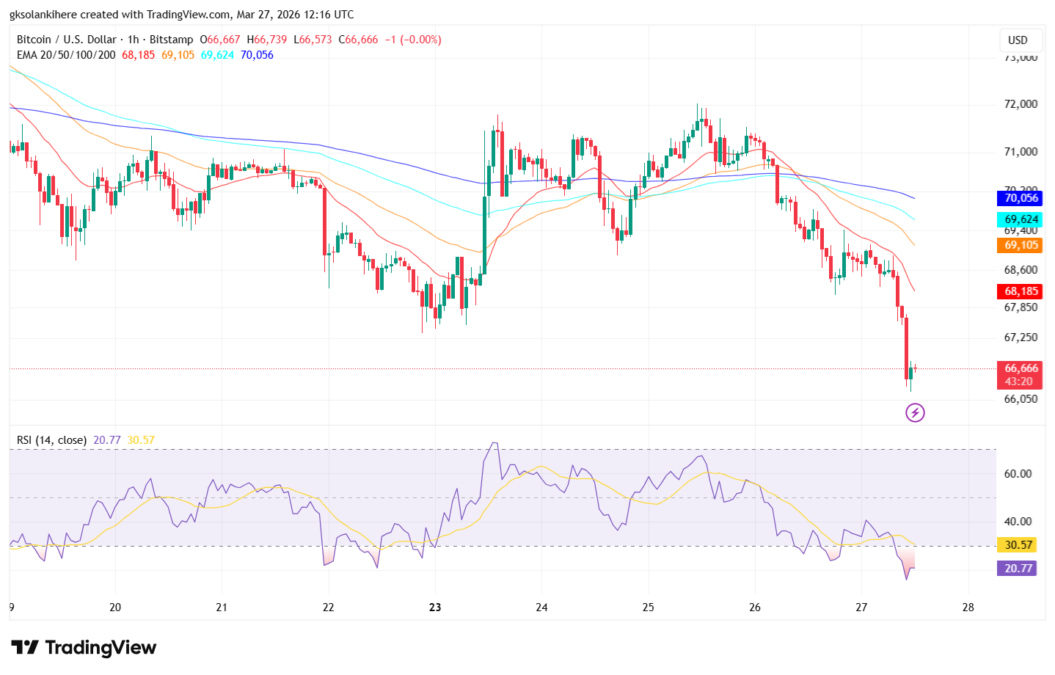
A sharp red candle drove BTC to the session low near $66,573, closing around $66,666. The price is now testing a critical short-term support zone around $66,000–$66,500. A decisive break below this level could open the door to further downside toward $65,000 or lower, especially if geopolitical risks escalate.
The RSI (14) stands at 20.77, deep in oversold territory (below 30). While this often hints at a potential short-term bounce or relief rally, in strong downtrends it can remain oversold for extended periods. Traders should watch for any divergence or RSI crossing back above 30 as an early sign of stabilization.
ETH loses $2,000 psychological support
Ethereum’s chart paints a similar picture of weakness. The asset has fallen below all major EMAs: EMA 20 ($2,046.34), EMA 50 ($2,082.15), EMA 100 ($2,105.60), and EMA 200 ($2,122.91). The steep red candle on the 1-hour timeframe pushed ETH to trade near $1,987, closing at $1,987.07 with a 3.54% daily loss.
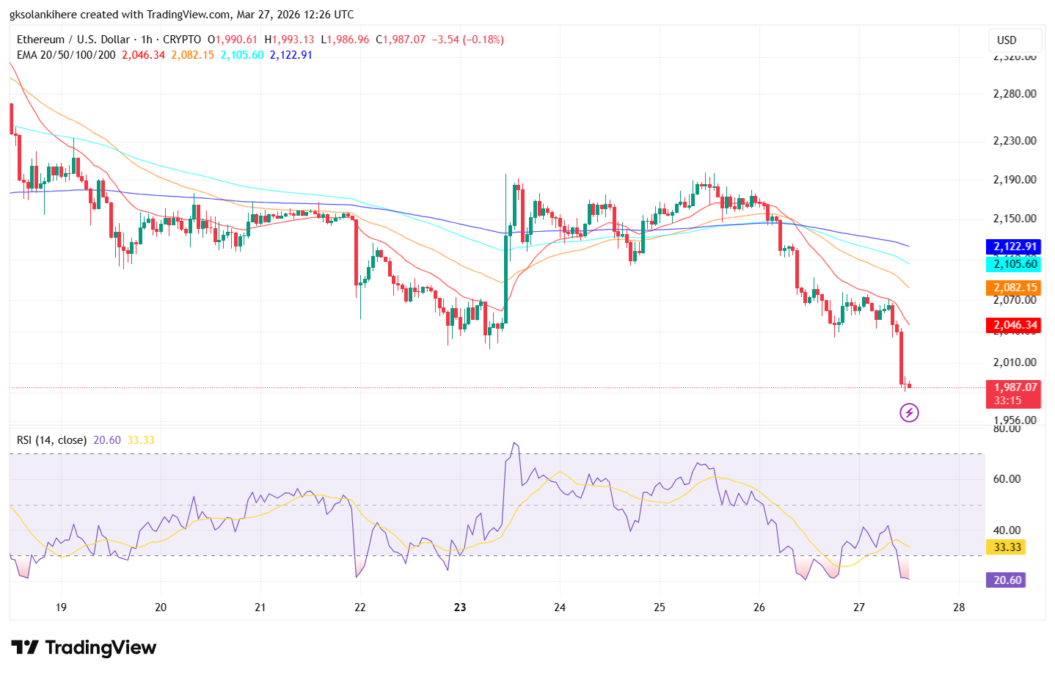
For ETH, next major support sits near $1,950–$2,000 level. A breakdown here would expose lower targets around $1,900 or even the $1,800 zone if selling accelerates. Resistance is now clustered around the EMAs, with the nearest at approximately $2,046.
The RSI (14) for ETH reads 20.60, also firmly oversold. This mirrors Bitcoin’s condition and indicates exhausted selling pressure in the very short term, though a sustained recovery would require broader risk sentiment to improve.
Both these charts show price trading well below their respective 20/50/100/200 EMAs, confirming a short-term bearish structure. The synchronized drop highlights crypto’s current high correlation with risk-off moves triggered by energy market shocks.
Broader context and market outlook
Rising oil prices from Hormuz disruptions typically stoke inflation fears, reducing expectations for Federal Reserve rate cuts and weighing on risk assets like Bitcoin and Ethereum. In March 2026, this dynamic kept crypto under pressure despite occasional de-escalation hopes.
For now, the market reflects accumulated stress from the Gulf more than panic over one unverified claim. At this time, separating fresh developments from recycled footage remains key when billions shift on headlines.
With tensions showing no quick resolution, volatility is likely to stick around next week. Traders should monitor oil price movements, any diplomatic updates on the Strait of Hormuz, and whether BTC can defend the $66,000 support or ETH holds above $1,950. A clear improvement in geopolitical sentiment could spark a relief rally, while renewed escalation risks deeper corrections.
Also read: Binance Faces $6.9M Fine in Australia Over Derivatives Access Lapses
