




























For much of the past decade, the evolution of digital assets has been framed through the lens of instruments. The conversation has revolved around Bitcoin, Ethereum, and, more recently, stablecoins. That framing, while useful in the early years, is beginning to feel inadequate.
What is unfolding now is not simply the emergence of new financial assets. It is a deeper reconfiguration of how money itself is controlled.
@media only screen and (min-width: 0px) and (min-height: 0px) {
div[id^=”wrapper-sevio-e0d3bc50-0aae-47cc-a8d7-f0c9a0cef941″] {
width: 320px;
height: 100px;
}
}
@media only screen and (min-width: 1650px) and (min-height: 0px) {
div[id^=”wrapper-sevio-e0d3bc50-0aae-47cc-a8d7-f0c9a0cef941″] {
width: 728px;
height: 90px;
}
}
window.sevioads = window.sevioads || [];
var sevioads_preferences = [];
sevioads_preferences[0] = {};
sevioads_preferences[0].zone = “e0d3bc50-0aae-47cc-a8d7-f0c9a0cef941”;
sevioads_preferences[0].adType = “banner”;
sevioads_preferences[0].inventoryId = “502576df-3ba9-44d6-aa0c-8d4d40954bc3”;
sevioads_preferences[0].accountId = “265767db-939a-4138-8819-ebf4e3d5d360”;
sevioads.push(sevioads_preferences);
Across markets, institutions and regulators are converging on a reality that was, until recently, largely confined to specialist discourse. Money is no longer just something that is held, transferred, or settled. It is becoming programmable. That shift, subtle at first glance, carries implications that extend well beyond technology and into the domain of authority, governance, and systemic power. A “control layer” refers to the embedded rules—coded, conditional, and monitorable—that determine where, when, and how money moves.
The scale of this transition is already visible. Widely cited market data indicates that stablecoin transaction volumes in 2025 surged past $33 trillion, marking a sharp year-on-year increase and placing them in direct comparison with some of the world’s largest payment networks. Market recaps have highlighted both the pace of this growth and the expanding institutional relevance of these instruments.
At the same time, projections from industry and policy research suggest that stablecoins, along with tokenized forms of money, could scale significantly over the next decade.
@media only screen and (min-width: 0px) and (min-height: 0px) {
div[id^=”wrapper-sevio-bf4b3de1-2d49-4069-adb2-b7d50bdcc555″] {
width: 320px;
height: 100px;
}
}
@media only screen and (min-width: 1650px) and (min-height: 0px) {
div[id^=”wrapper-sevio-bf4b3de1-2d49-4069-adb2-b7d50bdcc555″] {
width: 728px;
height: 90px;
}
}
window.sevioads = window.sevioads || [];
var sevioads_preferences = [];
sevioads_preferences[0] = {};
sevioads_preferences[0].zone = “bf4b3de1-2d49-4069-adb2-b7d50bdcc555”;
sevioads_preferences[0].adType = “banner”;
sevioads_preferences[0].inventoryId = “502576df-3ba9-44d6-aa0c-8d4d40954bc3”;
sevioads_preferences[0].accountId = “265767db-939a-4138-8819-ebf4e3d5d360”;
sevioads.push(sevioads_preferences);
In earlier writing, including Hidden Rails: How Stablecoins Are Adapting Global Finance Under Stress published in Top Coin Daily, the argument was that stablecoins were evolving into settlement infrastructure. What has become clearer since is that infrastructure is only the surface. Beneath it lies something more consequential, the emergence of a control layer where money can be directed, restricted, and governed through embedded logic.
From Ledgers to Power: A Historical Constant
Financial systems have always been defined less by the assets they hold and more by the mechanisms through which those assets are recorded and controlled.
The merchant banking networks of Renaissance Europe derived their influence not from ownership of goods but from their ability to maintain ledgers across geographies. The modern monetary system formalized this dynamic through the Bretton Woods Agreement of 1944, anchoring global liquidity within state institutions and reinforcing the idea that control over flows was as important as control over reserves.
Even later innovations followed this pattern. Offshore dollar markets allowed liquidity to circulate beyond domestic jurisdiction. Global messaging systems such as SWIFT connected banks but stopped short of determining settlement. Control remained tied to those who could define when and how transactions were final.
What distinguishes the current moment is not the existence of control, but its transformation. For the first time, control is becoming programmable.
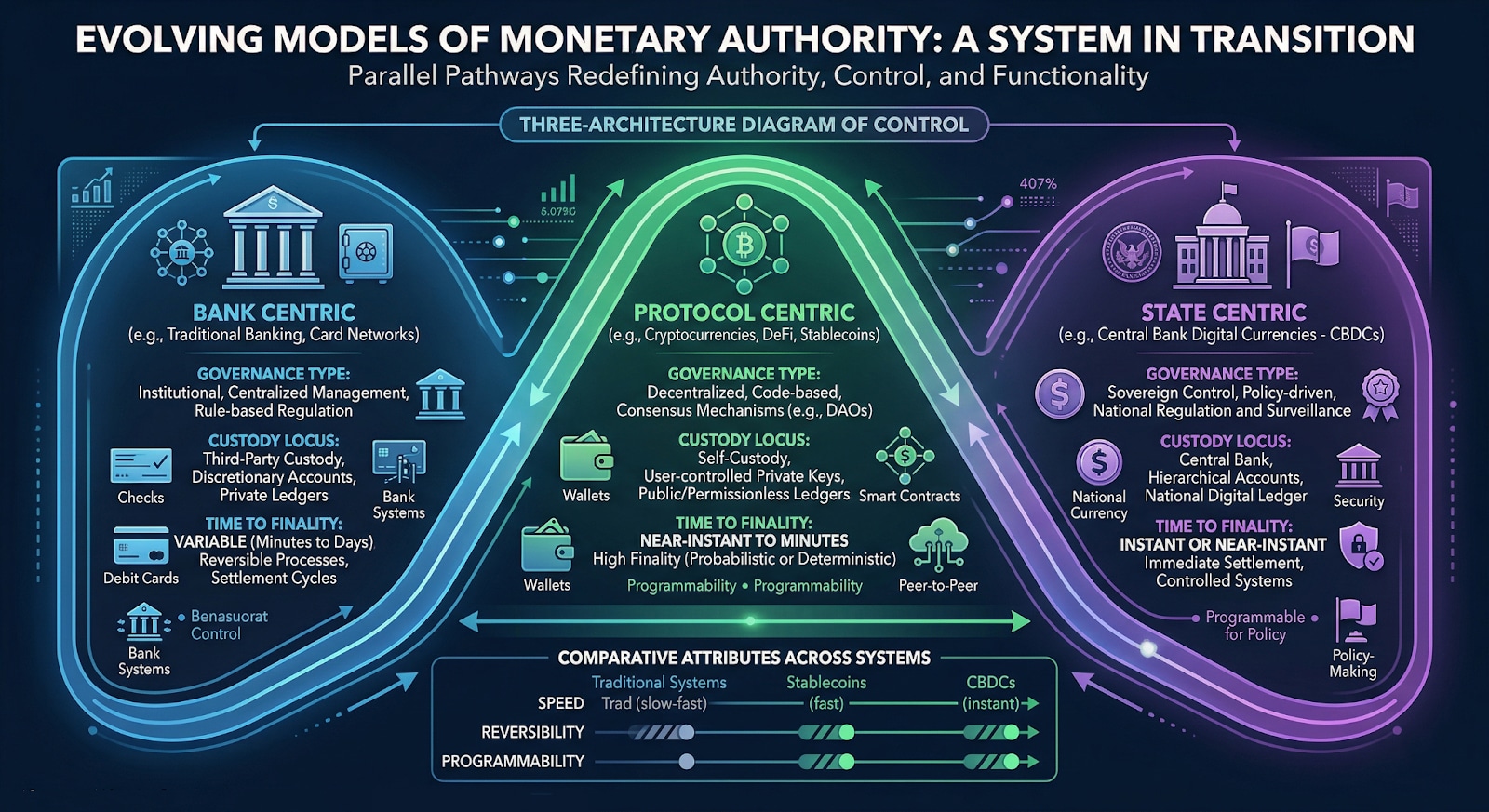
Three Competing Architectures of Monetary Control
This transformation is not producing a single dominant model. Instead, it is giving rise to overlapping architectures that reflect different approaches to authority.
The first is being shaped by traditional financial institutions. Banks are increasingly exploring tokenized deposits and digital representations of cash, seeking to combine regulatory trust with technological efficiency. Research from Oliver Wyman and Citigroup outlines how these systems could enable near instantaneous settlement while preserving existing governance structures. In this model, access is permissioned, transactions remain reversible under defined conditions, and compliance is embedded directly into the infrastructure. Banks do not relinquish control. They redesign it.
Running parallel to this is a second architecture driven by protocols rather than institutions. In decentralized systems, execution is determined by code, liquidity is pooled rather than intermediated, and settlement is often immediate. Global policy forums, including the World Economic Forum have highlighted how stablecoins operating within these ecosystems now facilitate transaction volumes comparable to traditional networks. The appeal lies in neutrality and programmability, but the absence of centralised oversight introduces challenges around governance, risk transmission, and recourse.
A third architecture is being advanced by states. Central banks across jurisdictions are developing digital currencies as instruments of monetary sovereignty. Policy discussions from institutions such as the International Monetary Fund and the European Central Bank emphasise both the opportunities and risks associated with privately issued digital money.
With stablecoins largely denominated in dominant currencies, concerns around currency substitution and loss of policy control have intensified. Central bank digital currencies respond to this by embedding policy capabilities directly into money itself, allowing for real time monitoring and conditional execution.
Three-Architecture
The Tension Layer: Where Systems Collide
These architectures do not evolve in isolation. They intersect, and in doing so, they generate tensions that are increasingly shaping the financial system.
Questions of monetary sovereignty now sit alongside the expansion of private digital currencies. The efficiency of instant settlement challenges long standing assumptions around reversibility and oversight. Protocol driven neutrality comes into friction with regulatory expectations of compliance. This is not a transition toward equilibrium. It is a contested space.
Recent policy analysis, including work highlighted in FinTech Weekly, reflects how the narrative has already shifted from speculative assets to regulated infrastructure. Policymakers are no longer asking whether these systems will persist, but how they should be governed.
The Hidden Core: Settlement and Finality
At the centre of this debate lies a concept that remains underappreciated outside specialist circles, that of settlement finality. In any financial system, true control resides with whoever determines when a transaction is irrevocably settled.
Historically, this role has been anchored in central bank systems or in physical settlement mechanisms. Payment networks have transmitted instructions, but finality has remained elsewhere. Programmable money alters this relationship. It allows transactions to settle instantly, conditionally, and across borders, compressing time in a way that traditional systems could not. In finance, time has always been a proxy for control. When settlement accelerates, control shifts.
Custody as the Interface of Control
Within this evolving landscape, custody is being redefined. It is no longer limited to the safekeeping of assets. It now operates at the intersection of technology, law, and governance.
Advances in cryptographic systems, including multi party computation and hardware based security, enable distributed control over assets. At the same time, they raise deeper questions. Who authorises a transaction, under what conditions, and within which jurisdiction becomes central to how the system functions.
Custody, in this context, is not passive. It is the interface through which control is exercised.
A System in Transition
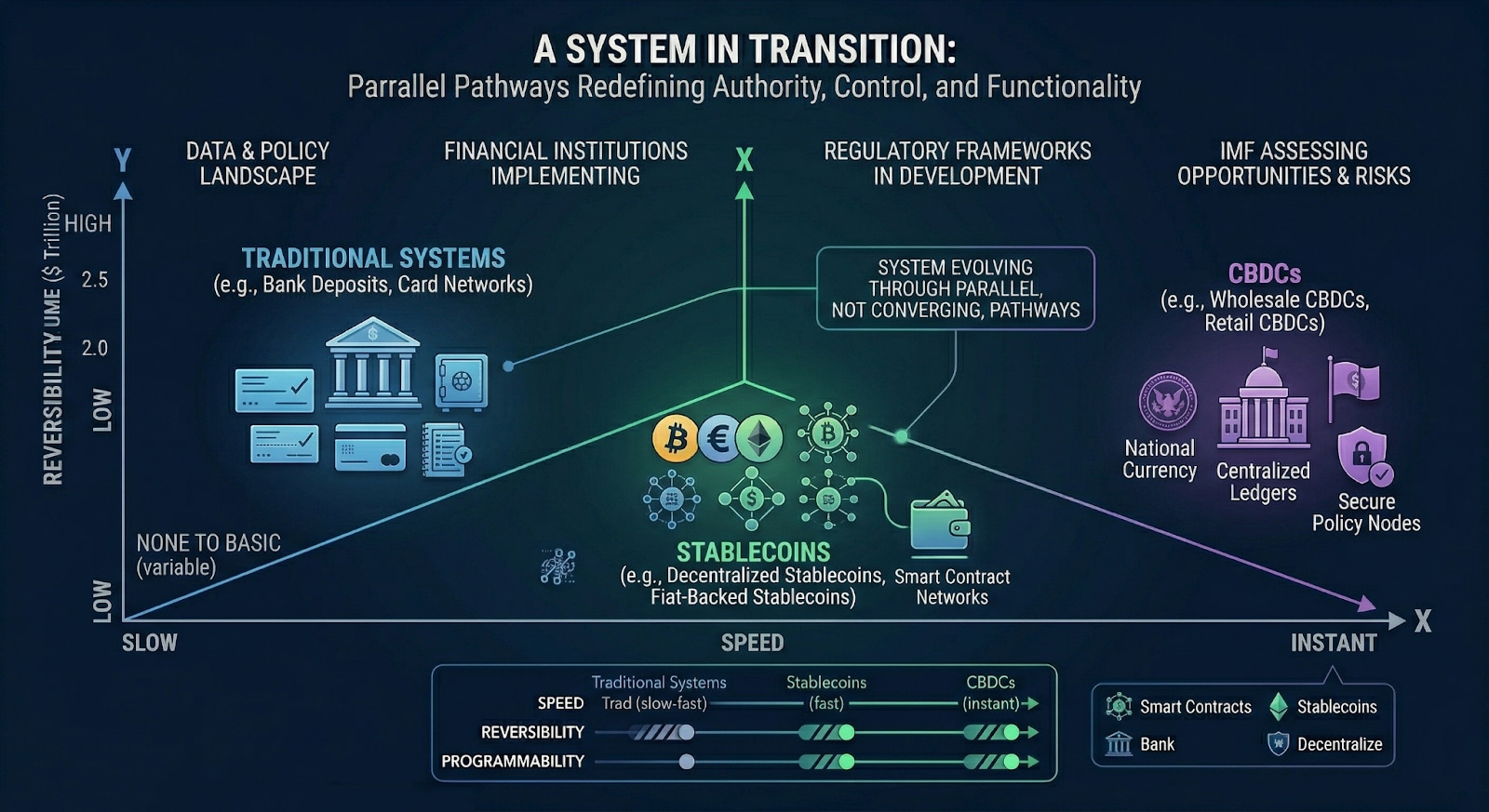
The broader trajectory is already visible in the data and policy landscape. A majority of jurisdictions are actively developing regulatory frameworks for digital assets. Financial institutions are moving from experimentation to implementation. Global organizations, including the International Monetary Fund, have begun to outline both the opportunities and systemic risks associated with programmable forms of money.
The system is not converging towards a single outcome. It is evolving through parallel and often competing pathways, each redefining how authority over money is structured.
Programmable Money Control Framework
Conclusion: Bending Financial Time
To understand where this leads, it is useful to step outside finance. In physics, the concept of time dilation describes how time is not constant. Under certain conditions, it can accelerate or slow relative to an observer.
Financial systems have always been constrained by their own version of time, defined by settlement cycles, clearing delays, and jurisdictional frictions. These constraints have historically determined who controls the system.
Programmable money changes that relationship. It reduces settlement times from days to seconds. It embeds rules directly into transactions. It allows value to move across systems and borders with a degree of flexibility that was previously unattainable.
In doing so, it bends financial time. And when time bends, control shifts.
The emerging contest in finance is therefore not about the assets that dominate balance sheets, but about the frameworks that determine how those assets move. It is about who sets the conditions for settlement, who retains the ability to intervene, and who ultimately governs the flow of capital in an increasingly interconnected system.
The future of finance will not be defined by who holds money, or even who issues it. It will be defined by who has the authority to program its movement, to shape its constraints, and to determine the moment at which it becomes final.
