





























For three decades, financial innovation has been measured in seconds. Faster wires replaced slower ones. Real-time gross settlement systems compressed reconciliation cycles. Instant payment rails became shorthand for national technological progress.
The logic seemed unassailable: the faster money moves, the more efficient finance becomes.
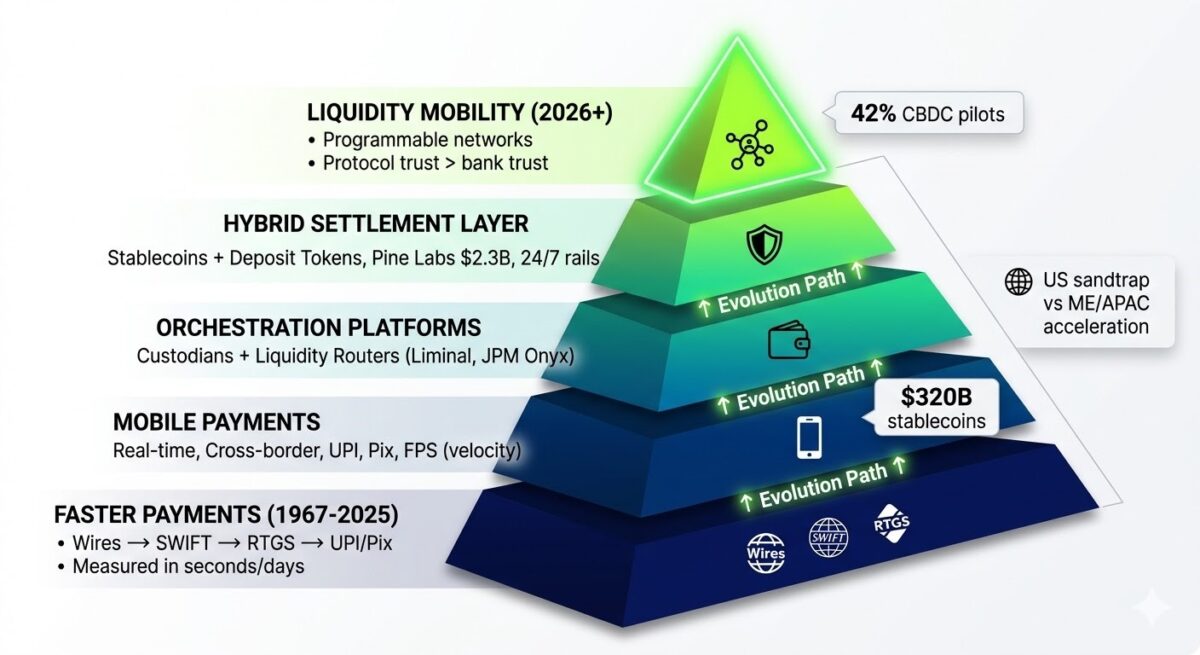
That assumption is now being tested. Across global markets, the deeper transformation is not about velocity but about fluidity. Liquidity itself—the core resource of banking, capital markets, and sovereign finance—is being redesigned to move across institutions, asset classes, and jurisdictions with growing programmability. Payments were merely the opening act.
From Faster Payments to Mobile Balance Sheets
The first wave of institutional digital-asset adoption focused on cross-border settlement. Traditional correspondent banking networks continue to remain robust, but rely on layered intermediaries, pre-funded nostro accounts, and delayed finality. In trade-heavy corridors, these frictions trap working capital and raise transaction costs.
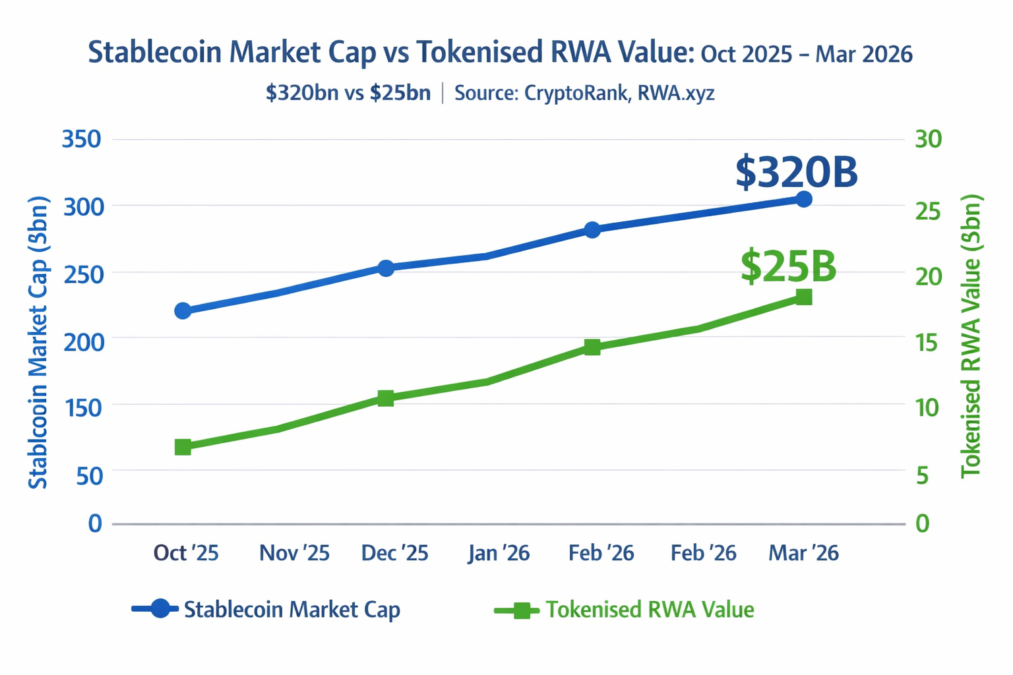
Stablecoins and tokenized settlement instruments promise a different architecture. By enabling near-instant transfers across blockchain networks, they offer treasury teams real-time visibility over global cash positions and reduce liquidity fragmentation. And their growth has been swift!
Market trackers estimate global stablecoin capitalization will exceed $320bn by early 2026, while firms from payment processors to commodity traders have begun experimenting with programmable settlement flows. A report by the Bank for International Settlements noted increasing institutional interest in tokenized liquidity tools, particularly for intraday funding efficiency.
On treasury desks, the implications are becoming tangible. At one multinational logistics firm in the Gulf, finance teams now simulate liquidity routing scenarios across both traditional banking channels and blockchain settlement pilots before deciding where to park working capital overnight. Such exercises were rare even two years ago.
If operational liquidity becomes mobile by design, the longstanding advantage of deposit stickiness—a quiet pillar of bank funding models—could gradually erode.
Regulation Moves at a Different Speed
The transition is uneven. In the United States, regulatory fragmentation used to slow corporate treasury experimentation despite parallel innovation in derivatives markets overseen by the Commodity Futures Trading Commission. However, this changed with the GENIUS Act being signed into law in July last year.
Financial centers such as Abu Dhabi Global Market and Singapore were a little faster in comparison in advancing tokenization sandboxes that allow asset managers and banks to test programmable settlement structures under supervisory oversight.
This divergence reflects a broader tension. Digital-asset innovation often advances through infrastructure pilots rather than sweeping policy reform. Accounting standards for tokenized assets remain unsettled, and many banks continue to manage blockchain initiatives in organizational silos. Yet cross-border trade flows create persistent incentives to reduce liquidity friction. Markets tend to innovate where regulation permits—and reroute where it does not.
When Balance Sheets Become Software
Tokenization is frequently described as the digital representation of financial assets. In practice, it is closer to the conversion of balance-sheet claims into programmable units capable of circulating across interoperable liquidity networks.
Large financial institutions have begun testing tokenized deposit frameworks for internal settlement and collateral mobility. The objective is not retail distribution but operational flexibility: reducing the time required to mobilize collateral, optimize intraday funding, and respond to market volatility. Analysts increasingly characterize the shift as a move from holding liquidity to orchestrating liquidity.
Smart-contract infrastructure reinforces this trend. Funds can be released, restricted, or reallocated automatically in response to margin calls, compliance triggers, or market signals. Clearing, settlement, and risk management begin to converge into continuous processes embedded within software. The result is greater capital efficiency—and potentially faster stress transmission. Liquidity spirals that once unfolded over days could propagate in minutes across interconnected digital funding channels.
Central banks are paying attention. A survey by the BIS indicates that many monetary authorities are exploring programmable features in wholesale and retail digital-currency pilots. The goal is not simply technological modernization but the preservation of monetary sovereignty within evolving tokenized ecosystems.
Winners vs. Losers
As financial power shifts from simple payment speed to liquidity intelligence, the industry is being divided into two camps:
The Winners:
- Agile Orchestrators: Corporate treasury teams—like the logistics firm in the Gulf—that simulate liquidity routing across both banking and blockchain channels to optimize working capital overnight.
- Adaptive Hubs: Jurisdictions like Singapore and the Abu Dhabi Global Market that provide “sandboxes” for testing programmable settlement under supervisory oversight.
The Losers:
- Legacy Inertia: Institutions relying on “sticky” deposits as a stable funding model may find that advantage eroding as operational liquidity becomes mobile by design.
- Regulatory Sandtraps: Regions burdened by fragmentation and slow policy reform, where accounting standards for tokenized assets remain unsettled and innovation is trapped in silos.
While “software-defined balance sheets” offer unprecedented capital efficiency, they introduce a new breed of financial instability. In a traditional crisis, friction provides a “buffer”—the time it takes for humans to react and reconcile. In a world of programmable liquidity, smart-contract infrastructure can release, restrict, or reallocate funds automatically based on market signals or compliance triggers. This means liquidity spirals that once took days to unfold could propagate in mere minutes, creating tightly coupled “cascades” that outpace human intervention.
Infrastructure Power and Monetary Influence
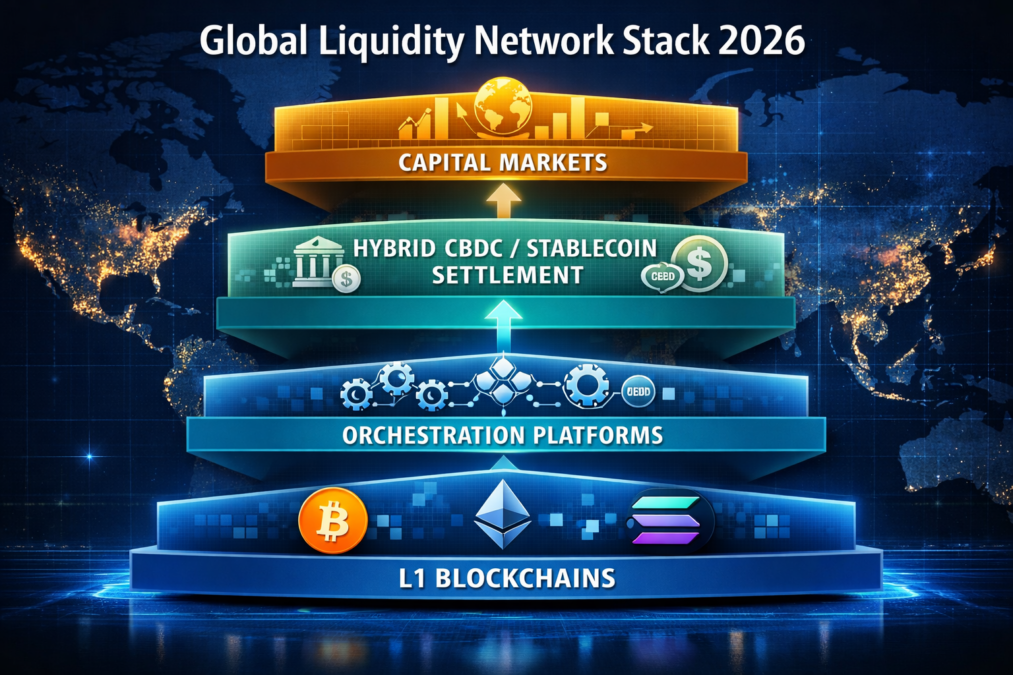
As liquidity becomes mobile and software-defined, infrastructure providers gain strategic importance. Custodians, blockchain settlement networks, and liquidity-orchestration platforms are evolving from operational facilitators into systemic nodes in financial architecture.
Some banking research notes already compare emerging tokenization platforms to the correspondent banking networks that underpin today’s cross-border finance—with one crucial difference. Influence in programmable liquidity systems may depend less on balance-sheet size and more on protocol adoption. Jurisdictions capable of hosting trusted liquidity-routing infrastructure could attract capital seeking efficiency and regulatory clarity.
The geopolitical implications are substantial. Stablecoins linked to reserve currencies may extend sovereign financial influence into digital markets. Conversely, fragmented network standards could challenge the traditional “singleness of money” that central banks have long sought to preserve.
The Next Financial Cycle
The shift from faster payments to programmable liquidity marks a deeper redefinition of financial efficiency. Speed remains valuable, but adaptability is becoming decisive. Institutions able to reallocate liquidity dynamically across networks—rather than merely across currencies—are likely to gain structural advantage in volatile markets.
For corporate treasurers, strategic questions are beginning to change. The choice is no longer only which bank to trust but rather increasingly which settlement architecture to rely on. By the early 2030s, liquidity networks themselves may be treated as asset-allocation decisions.
Financial crises of the future may arise not only from excessive leverage but also from automated liquidity cascades triggered by tightly coupled smart-contract systems. Monitoring liquidity velocity in real time could become as important for policymakers as tracking inflation or credit growth.
Payments innovation will then be remembered as the catalyst rather than the destination. Balance sheets will have become software. Monetary influence will depend partly on network design.
In finance, solidity has always implied safety. In the coming cycle, resilience may therefore instead depend on the intelligent management of liquidity in motion.

