


























Key Highlights
- Bill Cassidy and Cynthia Lummis introduced the “Mined in America Act” to reduce reliance on Chinese mining hardware.
- The bill proposes a certification program and phases out adversary-linked ASICs by 2030.
- It links U.S. mining to national strategy by supporting domestic manufacturing and expanding the Strategic Bitcoin Reserve.
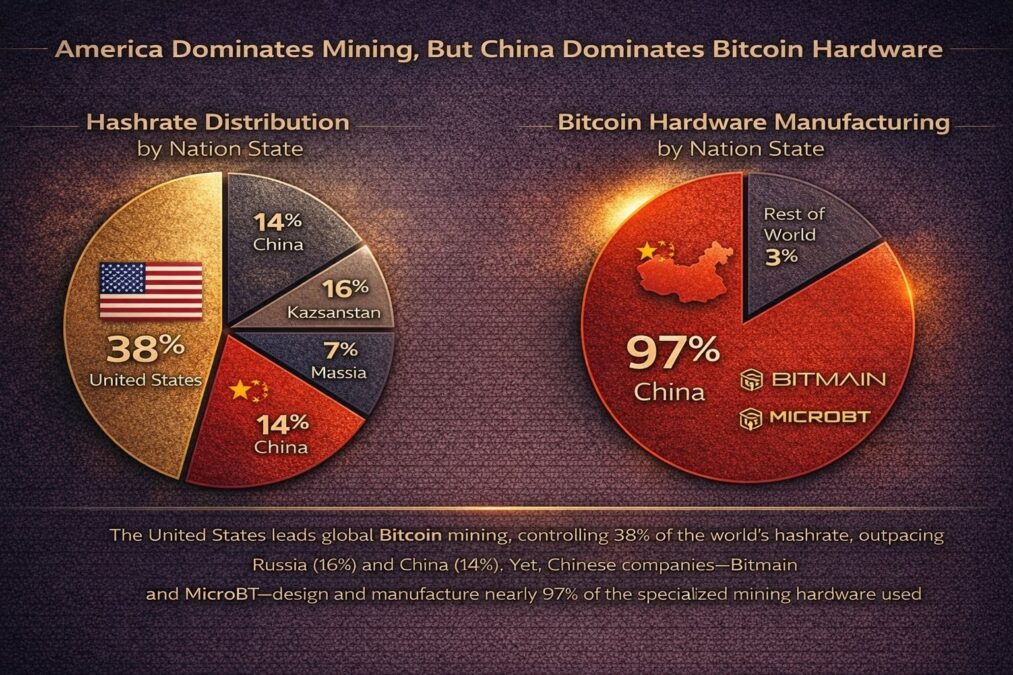
The United States commands nearly 38% of the world’s Bitcoin mining capacity, supporting a multi-billion-dollar industry that stabilizes power grids and boosts rural economies. Yet, a shocking vulnerability persists: 97% of the specialized hardware powering this dominance originates from China. This exposes U.S. operators to supply chain risks, tariffs, and possible bans.
@media only screen and (min-width: 0px) and (min-height: 0px) {
div[id^=”wrapper-sevio-e0d3bc50-0aae-47cc-a8d7-f0c9a0cef941″] {
width: 320px;
height: 100px;
}
}
@media only screen and (min-width: 1650px) and (min-height: 0px) {
div[id^=”wrapper-sevio-e0d3bc50-0aae-47cc-a8d7-f0c9a0cef941″] {
width: 728px;
height: 90px;
}
}
window.sevioads = window.sevioads || [];
var sevioads_preferences = [];
sevioads_preferences[0] = {};
sevioads_preferences[0].zone = “e0d3bc50-0aae-47cc-a8d7-f0c9a0cef941”;
sevioads_preferences[0].adType = “banner”;
sevioads_preferences[0].inventoryId = “502576df-3ba9-44d6-aa0c-8d4d40954bc3”;
sevioads_preferences[0].accountId = “265767db-939a-4138-8819-ebf4e3d5d360”;
sevioads.push(sevioads_preferences);
To possibly bypass these risks, Senators Bill Cassidy (R-LA) and Cynthia Lummis (R-WY) introduced the “Mined in America Act” on March 30, 2026. The legislation aims to certify domestic mining, phase out adversary-linked gear, and codify U.S. President Donald Trump’s Strategic Bitcoin Reserve into law.
As enforcement actions like 2024 port seizures of Chinese Application-Specific Integrated Circuits (ASICs) highlight the urgency, this act frames Bitcoin mining not just as a crypto play but as an important infrastructure similar to semiconductors. With U.S. miners already navigating thin margins amid $30-35/PH/day hash prices, the bill arrives at a pivotal moment for national security and economic resilience.
Significance of ‘Mined in America Act’
Senators Bill Cassidy of Louisiana and Cynthia Lummis of Wyoming formally introduced the Mined in America Act on Monday. The core aim is to establish a voluntary “Mined in America” certification program administered by the Department of Commerce for Bitcoin mining facilities and mining pools operating in the United States.
@media only screen and (min-width: 0px) and (min-height: 0px) {
div[id^=”wrapper-sevio-bf4b3de1-2d49-4069-adb2-b7d50bdcc555″] {
width: 320px;
height: 100px;
}
}
@media only screen and (min-width: 1650px) and (min-height: 0px) {
div[id^=”wrapper-sevio-bf4b3de1-2d49-4069-adb2-b7d50bdcc555″] {
width: 728px;
height: 90px;
}
}
window.sevioads = window.sevioads || [];
var sevioads_preferences = [];
sevioads_preferences[0] = {};
sevioads_preferences[0].zone = “bf4b3de1-2d49-4069-adb2-b7d50bdcc555”;
sevioads_preferences[0].adType = “banner”;
sevioads_preferences[0].inventoryId = “502576df-3ba9-44d6-aa0c-8d4d40954bc3”;
sevioads_preferences[0].accountId = “265767db-939a-4138-8819-ebf4e3d5d360”;
sevioads.push(sevioads_preferences);
Senator Cassidy emphasized the economic imperative: “Digital asset mining is a big part of our economy. We should be doing it here in America. This bill will secure supply chains, back U.S. manufacturing, and support this industry.” Senator Lummis tied the measure directly to Trump’s vision: “President Trump pledged to make the United States the digital asset capital of the world—and we’re not backing down.”
The bill also codifies key elements of President Trump’s March 6, 2025, Executive Order that established the Strategic Bitcoin Reserve and U.S. Digital Asset Stockpile. The order directed the Treasury to treat approximately 200,000 bitcoins (primarily from law enforcement forfeitures) as a long-term national reserve asset, not to be sold but held strategically.
The legislation provides statutory backing, creates mechanisms for certified miners to sell newly minted BTC to the Treasury on a tax-advantaged basis, and ensures the policy has stronger congressional grounding beyond executive action.
This transition highlights a fundamental vulnerability: America leads in computational power devoted to Bitcoin’s security, yet the physical tools enabling that dominance remain overwhelmingly foreign-controlled.
China’s mining monopoly exposed
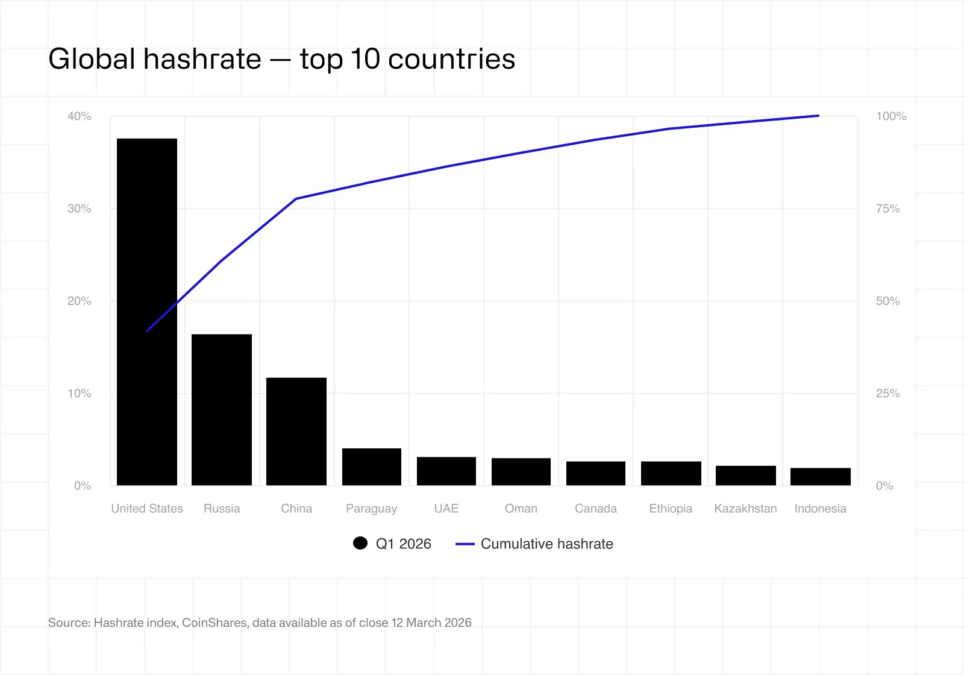
Q1 2026 data from CoinShares underscores the imbalance. The United States holds roughly 38% of global Bitcoin hashrate (with estimates around 37.5% or ~400 EH/s earlier in the period), while Russia and China trail at about 17% and 13%, respectively, for a combined top-three share of ~68%.
Despite the U.S. post-2021 rebound after China’s domestic mining crackdown, the hardware layer tells a different story. Chinese firms such as Bitmain, MicroBT, and Canaan dominate global ASIC production. According to the Cambridge Digital Mining Industry Report, Bitmain accounts for approximately 82% of production, MicroBT for 15%, and Canaan for about 2%, giving the three firms a combined share of roughly 99% of the global market.
This creates a strategic chokehold. Even as hashrate migrated to friendlier jurisdictions after 2021, the supply of efficient SHA-256 ASICs remained concentrated in China. Risks include potential export restrictions amid geopolitical tensions, firmware vulnerabilities that could compromise network security or enable surveillance, and sudden disruptions that might idle gigawatts of U.S. mining capacity.
Industry voices, including Dennis Porter of the Satoshi Action Fund, have described the situation: America controls 38% of the world’s hashrate, but 97% of the hardware comes from China. “That is not leadership, that is a liability,” Porter said.
The following table illustrates the disparity:
| Metric | U.S. Share | China Hardware % |
|---|---|---|
| Hashrate | 37-38% | N/A |
| ASICs (Mining Rigs) | <5% domestic production | ~97% |
This hardware dependence persists despite U.S. advantages in energy markets, capital access, and regulatory improvements. The Mined in America Act directly confronts this asymmetry by incentivizing a shift toward domestically or allied-produced equipment.
Breaking down the provisions
The legislation centers on a voluntary certification program managed by the Department of Commerce. Mining facilities and pools seeking the “Mined in America” label must meet standards for hardware provenance (sourcing from non-adversary nations) and cybersecurity. Certification is not mandatory, allowing operators flexibility while creating strong market incentives through access to federal programs and tax benefits.
Key phase-out rules include the following:
- No new purchases of hardware from designated foreign adversaries (including Chinese firms like Bitmain and MicroBT) after January 1, 2027.
- Full transition away from such equipment required by the end of the decade (approximately January 2030 for certified operations).
The bill directs the National Institute of Standards and Technology (NIST) and the Manufacturing Extension Partnership (MEP) to support U.S. and allied manufacturers in developing secure, energy-efficient ASIC alternatives, effectively extending industrial policy tools similar to those in the CHIPS Act toward Bitcoin mining hardware.
Certified operations gain integration into existing federal initiatives, such as Department of Energy grid-stabilization efforts, USDA rural development programs, and renewable energy incentives, without requiring new appropriations. A pivotal link to the Strategic Bitcoin Reserve allows certified miners to sell newly mined BTC directly to the Treasury, creating a predictable buyer and helping grow the national holdings in a budget-neutral manner.
The bill text and summaries emphasize these elements, framing the program as a way to “use Federal programs and incentives to support domestic manufacturing and secure digital asset infrastructure.” The voluntary nature and lack of new spending are designed to ease passage while still driving meaningful change through economic signals.
Industry and market impacts
Proponents highlight multiple dividends. Bitcoin mining can act as a flexible load for grid stabilization, absorbing excess renewable or stranded energy (such as flared natural gas) and providing demand-response services. Certified domestic operations could anchor jobs in semiconductor fabrication, assembly, and R&D, particularly benefiting rural and energy-rich states like Texas, Wyoming, and North Dakota.
The pipeline to the Strategic Bitcoin Reserve, which already holds significant seized BTC, would support steady reserve growth while rewarding American miners.
The potential downsides include transition costs for operators replacing existing rigs and possible short-term hashrate impacts during the phase-out. In a bear case, overly rigid rules could push some activity offshore or slow deployment. In the bull case, the legislation catalyzes a U.S. hardware boom, fosters innovation in efficient and secure ASICs, and strengthens overall network resilience.
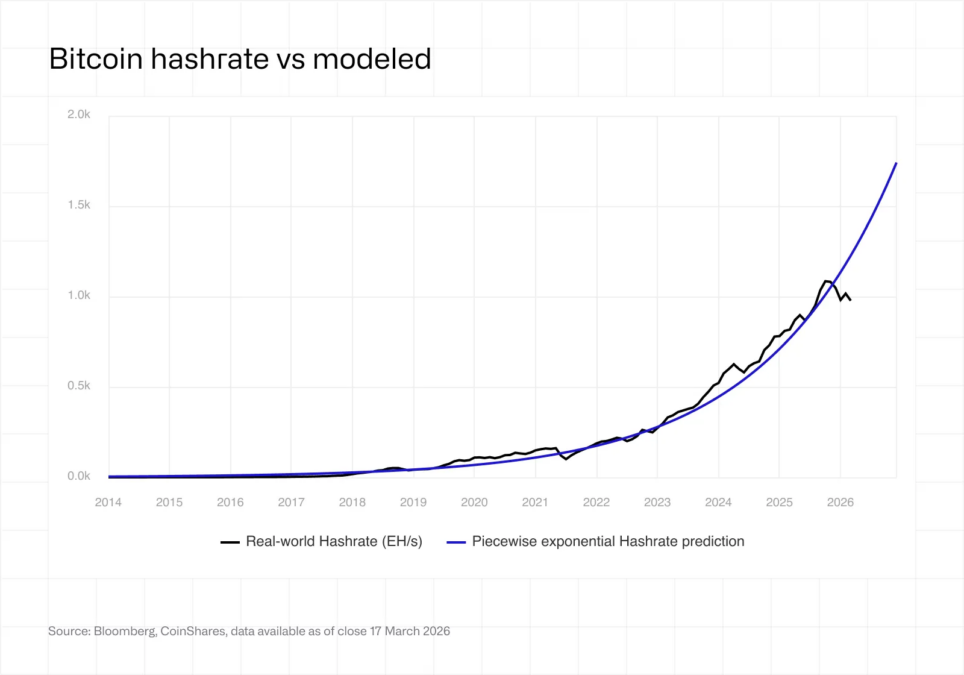
CoinShares’ Q1 2026 Bitcoin Mining Report provides useful context, noting recent hashrate fluctuations (a temporary dip after 2025 peaks) but forecasting growth toward 1.8 ZH/s by year-end, contingent on market conditions. Visuals from such reports, including geographic hashrate distributions and hardware deployment trends, underscore both U.S. computational leadership and the persistent manufacturing gap the bill seeks to close.
Broader effects could extend to energy markets, where mining monetizes underutilized power, and to national security by reducing single-point supply risks.
Political momentum and ties
The Mined in America Act aligns closely with President Trump’s repeated pledges to make the United States the “digital asset capital of the world.” It builds on the 2025 Strategic Bitcoin Reserve Executive Order and complements other pro-crypto developments, such as evolving SEC approaches and progress on stablecoin or market structure legislation (including elements of the Clarity Act).
The timing, in a post-2024 landscape with stronger Republican congressional positioning, enhances momentum, though passage will still require navigating committee processes and securing broader support.
Bipartisan potential exists around themes of supply-chain security, rural economic development, and energy infrastructure resilience, especially as midterms approach. The voluntary structure and absence of major new spending lower political friction compared to more interventionist proposals.
Outlook and next steps
The passage odds appear favorable given the bill’s pragmatic design: voluntary certification reduces opposition from free-market advocates, while ties to Trump’s agenda and existing industrial tools broaden appeal. Miner response will be critical; early adoption of certification could accelerate domestic manufacturing investments and demonstrate the program’s viability.
The challenges include finalizing detailed certification criteria, ensuring the phase-out does not create unintended vulnerabilities during transition, and addressing any environmental or centralization critiques through emphasis on efficient, grid-supportive operations.
Why this legislation is important for the U.S. crypto landscape
The “Mined in America Act” goes beyond mining policy—it marks a structural shift in how the United States approaches digital assets as part of its economic and national security framework. By targeting the hardware layer, the bill addresses one of the most overlooked vulnerabilities in crypto: supply chain dependence. Reducing reliance on Chinese-manufactured ASICs strengthens operational continuity for U.S. miners and mitigates the risk of sudden geopolitical disruptions that could impact a significant share of global Bitcoin hashrate.
Moreover, the legislation integrates Bitcoin mining into broader industrial policy. Much like the semiconductor push under the CHIPS Act, it positions mining infrastructure as strategically relevant, encouraging domestic manufacturing, R&D, and job creation. This elevates crypto from a largely financial or speculative domain into a recognized pillar of U.S. technological competitiveness.
Also Read: Trump Appoints Pro-Crypto Todd Blanche To Lead DOJ As Bondi Exits
